“Ting” by Scapino Ballet and Nits
“She is pregnant like a raindrop, Ting Ting”.
I have always loved this line. Henk Hofstede models and shapes a musical world out of moving images. Images of movement have always been a crucial part of Nits’ playing field. Rob Kloet rowing in a little boat across a river in the Dutch mountains, the Panorama man’s playful acrobatics with a chair on a rooftop, and my favourite, the dreamy, smiling girl on the swing, balancing on the “dizzying vertigo” (RG) of “The Eiffel Tower”. The shirts and towels turning around in a dryer in the kitchen, a shirt waving in the meadow or a blouse dripping on a clothes-line in the attic, the soft and gliding movements of water and the caressing brushes of the wind were always on the forefront of their lyrical wanderings. So with water and wind on my mind, I was ready to enter the turmoil of the dancing replica of the Nits universe with the iconic tables and chairs… My rêverie of water was soon materialized at the start of the show by a bucket filled with water and one of the male dancers washing, immersing his long black hair in the water with only the sound of the water being heard. Water in all its forms is at the core of the Nits world, their philosophy of music is written in it, “The river is a synthesizer”. In their music Nits have furthermore construed a little philosophy of both movement and being, always in connection with the shapes and colours of the world. Ed Wubbe couldn’t have chosen a better pop sound for his young dancers to revel in, nor a better world so full of fantasy, surprise and wonder as offered by Nits’ musical touches of our everyday world. But things aren’t that simple…
The language of dance is of course primarily one of movements, and in a lesser way, one of mime and perhaps of mimicry. In dance we see movements through a magnifying glass, enlarged and dramatised, beautified, stretched to their limits, or dissected into little pieces.The language of dance is characterised by randomness, orchestrated coincidences, movements are not bound by semantics or grammar, looser and more abrupt than music, more flexible than our spoken language, only limited by the physical constraints of the human body. Movements translate a very pristine, uncorrupted, primal instinct, they seem to be our first language, articulated, but ambiguous and confounding, unclear as to their meaning (sometimes), formed, but open and free. Nowhere else are incompatibilities and contradictions in one and the same discourse, so well tolerated as in the dancing language of movements: attracting and repulsing, falling down and rising up, approaching and withdrawing, embracing and pushing away, folding back on oneself or reaching out to others, scanning one’s own body and its limits, limiting others or giving them instead all the space they need…to dance. Only dance seems to withstand so much tension within itself, it’s elastic, primitive and raw even when it’s taking on the disguise of the most gracious and studied choreographies; there is something so pure about it…The instinct to move allows just about anything. So, although there’s not a story that is being told, we seem to be able to identify spontaneously with these moving sketches of our “condition humaine”. And that’s just the way it goes in “Ting”. The dancers’ movements play with the time frame offered by the music, seduced by the music, their ally and challenger, their sparring partner.
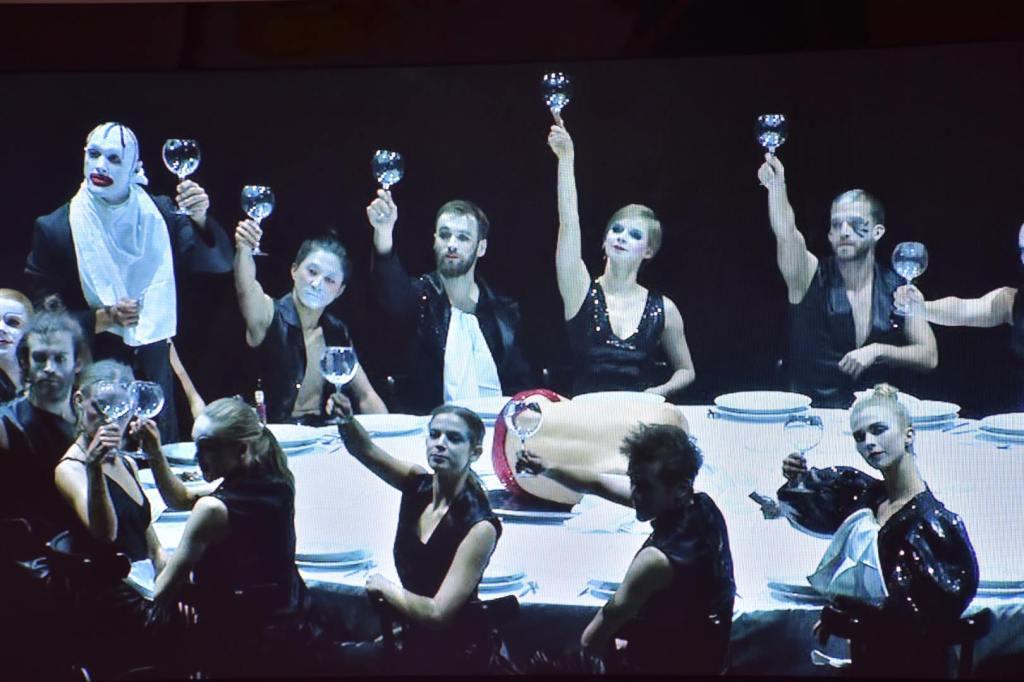
I get the loveliest sensations listening to Nits music: it makes me think and feel, long and muse, regret and hope, dream, feel happy. All these different moods Nits evoke so effortlessly in their music are very difficult to transpose to the dance movements. Music has a way of touching the soul that is quite unique, Nits music especially, and the abundance of manoeuvres and gestures, and the hectics of the busy dancers don’t always leave enough space for us to undergo these moods and be taken in by them. The sense of melancholy in Nits music perhaps most of all suffers from the “buzziness” on stage. Melancholy needs the pause, the quiet of a moment of reflection, a sort of focus of the mind, standing still while still moving in time. Music can provide this sort of moments, dance can too, but only seldom. I think “The Swimmer” comes closest here to expressing the feeling of melancholy and longing, beautifully danced by the two star dancers from Scapino, the wonderful Bonnie Doets (whose big wistful eyes and distinctive looks make her a dancing actress) and her swimming partner, – and maybe also the protagonist and narrator of this charming dancing tale – the multifaceted Mischa van Leeuwen. The opening sequence of the show with the eerily unadorned, almost bare version of “ Two Skaters”, had, however, sketched so beautifully the kinship between music and movement. The song, emptied of its vocal lines, stripped to the bones, was merely brought to life by a few essential strokes and touches of the instruments, accompanying the chimerical, shadowy figures projected on the white curtains, a haunting allegory of images and sounds, revealing the intricate link between music and our imagination, between music and illusion, disclosing how beauty arises from the purest, most simply delineated rapport or exchange between two elements, between music and movement. Those cryptic, enigmatic lines of moving sounds and images, were a delicious appetizer for what was yet to come. It was like a portrait of rhythm, not only in sound, but also in vision, the slow movements of the dancers who metamorphose into stylists of rhythm. A cinematic suspense in Hitchcock style… But going through the motions, I started to get the feeling that Nits music agrees more with acrobatics than with dance movements as such. It must be their theatrical, often lingering, wandering, reflective style of making music that makes these acrobatic intermezzos so very suitable. “Around the Fish”, was delightfully pictured by the caterpillar girl on the rope, her swirling movements, diving and climbing, lending a tangible concreteness to this strange song, a palpability that suits Nits perfectly. The best choreographies were those that included some kind of objects; Nits love things, be it a rope, a big translucent ball, chairs or a table, a bicycle of some sorts, – a children’s tricycle to be precise – tableware, napkins and a tablecloth, anything really, – except for the hats maybe, there were too many of them too often, in a very cliché like manner, in a what-shall-we-do-next-with-the-hats? kind of way, not very Nitsy – that brings our everyday world into the dancers’ realm. Their down-to-earth matter of factness found a very unlikely and surprising partner in the acrobats whose controlled and rigid, statuesque movements offered a corporeality that goes very well with Nits’ picturesque but sturdy and kinetic sense of all things material. I must say the acrobatics were quite impressive: a Rapunzel girl hanging down from the rope only attached by her long hair, and the duet on “The Long Song”, the strength in the arms of the boy lying on the ground, and the grace and cautiousness of the girl he supported. But my favourite moment was “Walter and Connie” setting the table: the interaction of the dancers and acrobats with things like plates and glasses, napkins, chairs and the unfolding of the tablecloth were just charming. There should have been more moments like these in the show, with concrete, material references to our Lebenswelt. I imagined dancers picking apples from the trees, eating strawberries at the kitchen table … They should have brought more things to “Ting”, of all colours (not only blue things) and shapes, to play with, to dance with.
This playfulness of Nits was pleasantly portrayed in the childlike, sweetly naive goings-on of “Giant Normal Dwarf”, but there’s also this whimsical, darker, wayward element in the setting, it’s a man who is wearing the “beautiful dress”, his face covered by his long black hair. The show is full of these black, ominous, sinister, a bit creepy details that have no link really with Nits themes, like the girl sharpening her knife at the end of the show. I suspect Ed Wubbe wanted to add some kind of edge, a gloomy touch to the whole performance, or some kind of dark humour, but I don’t know if that really works with Nits. It takes away from their unspoiled, direct and innocent way of presenting their art and making music and makes the whole experience somewhat more superficial and forced. Of course it wasn’t necessarily the choreographer’s intention to make a portrayal in dance of the typical Nits world. I suppose it wasn’t really. In the end I left the show with mixed feelings. Nits’ fantasy world is earthly and concrete with a surreal touch, and the abstract dancing routines don’t always favour the inwardness, the intimacy and the profoundness hidden in the sweet forms of their music. The perspicacity and depth of their songs is partly due to the pure and unadulterated connection they make with our material world of concrete forms and colours; the physicality of the dancers, their bodies and movements are part of this world and should have been more exploited in this way. But it was nice and I felt a lot of sympathy for the dancer disguised as a sort of “Pierrot”, he made me laugh at times, even moved me, almost as much as Nits usually do…
Joke Roelandt, September 2018
 Larissa on the Windowsill
Leave a comment